Keshequa / Nunda Basketball:
Individual Game Scoring Leaders
by Bob Gelser
Basketball has gone through several transitions in the last 100 years. Rule changes have changed the style of play and the potential for one of our local basketball players to hold the title of Individual Game Scoring Leader.
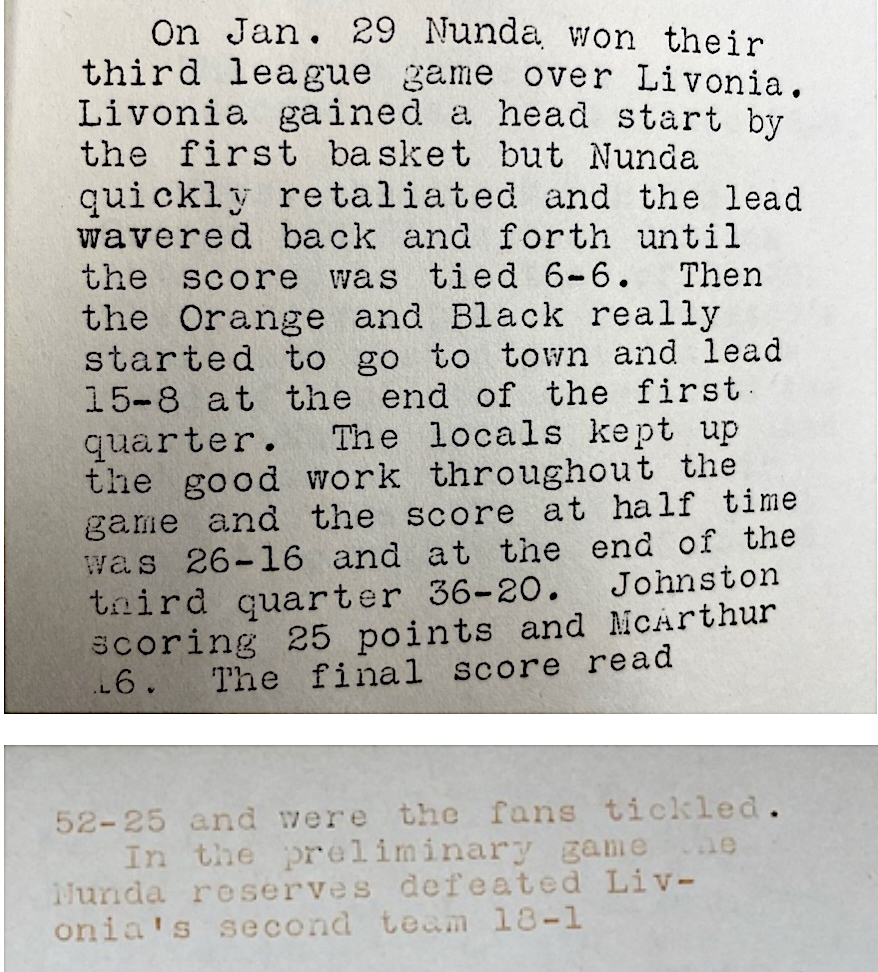
In 1937, the common rule was after every scored basket, to have a jump ball at center court. For a team that had a tall center it was easy to control a game and possession of the ball as a tall center with good jumping ability could tap the ball to an open teammate and limit the possessions of an opposing team. Nunda had such a center with “Big” Ben Johnston in the 1936-37 season. In that season Big Ben set the single game scoring record of 25 points. The Nunda School Newspaper, “The Gab” reported the following.
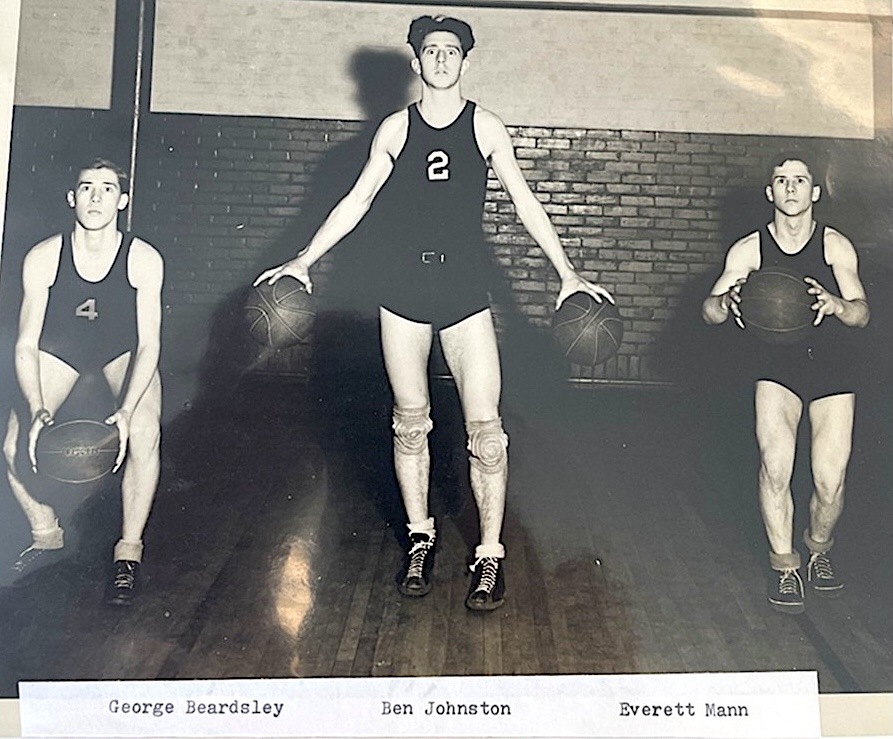
As seen in the photo below, Ben Johnston was quite a dominating player for any team that played against Nunda.
After the 1936-37 season, the high school rule was changed limiting jump balls to the start of every quarter with possession being given to the alternate team after a scored basket. This made it more critical for good ball handlers and the ability to run an efficient offense to allow a team to score. In 1940, Lawrence “Ernie” Gollmade a run at the record, falling 5 points short with a 20 point performance. What made this effort so remarkable was that there were no home games for Nunda with limited practice facilities that season. As reported in the Nunda News, “Due to the fact that the new Central school was in process of being built and the old gym had been demolished, the Village building was converted into a semi-basketball court by erecting one basket and by pushing the chairs which were used during the day in a classroom around the walls. This left a space approximately 25 x 30 and only 12 feet high which eliminated the ability to practice long range shooting.” Ernie Goll is shown below holding the basketball with the rest of the 1939-40 Nunda Basketball team.
Ernie Goll is shown below holding the basketball alongside the rest of the 1939–40 Nunda basketball team.
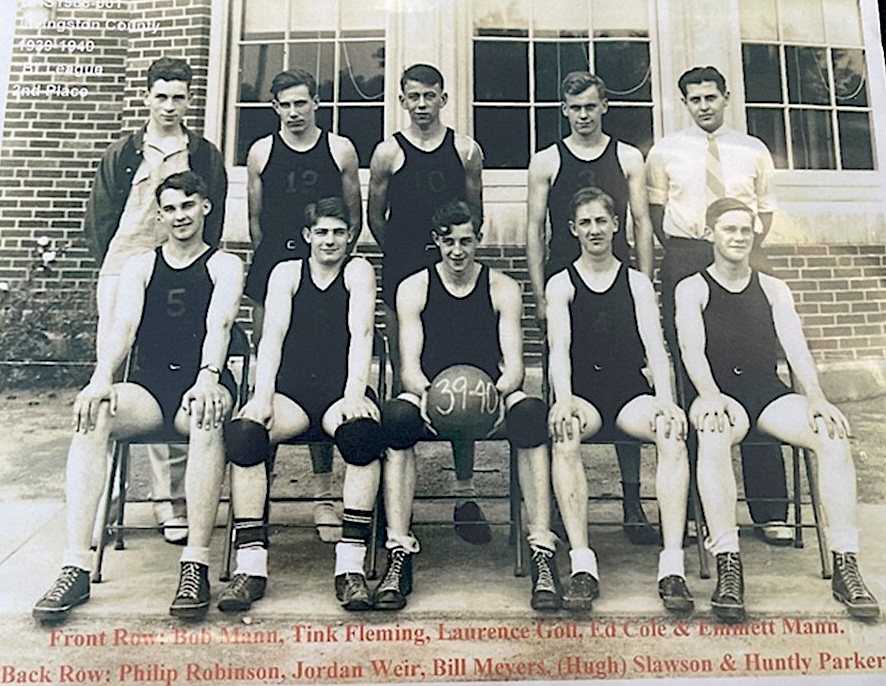
The 1939–40 Nunda basketball team, with Ernie Goll holding the ball.
The next season, Ernie Goll’s former teammate Emmett “Squat” Mann fell 3 points short of breaking the record with a 22 point performance. Scoring over 40 points as a team was rare in the 1940’s, and Emmett’s performance allowed Nunda to beat Avon by 43-33. Unfortunately for the home fans the game was played at Avon and not in the newly constructed gym. Emmett Mann #7, is shown with his 1940-41 teammates below including Jake Essler!
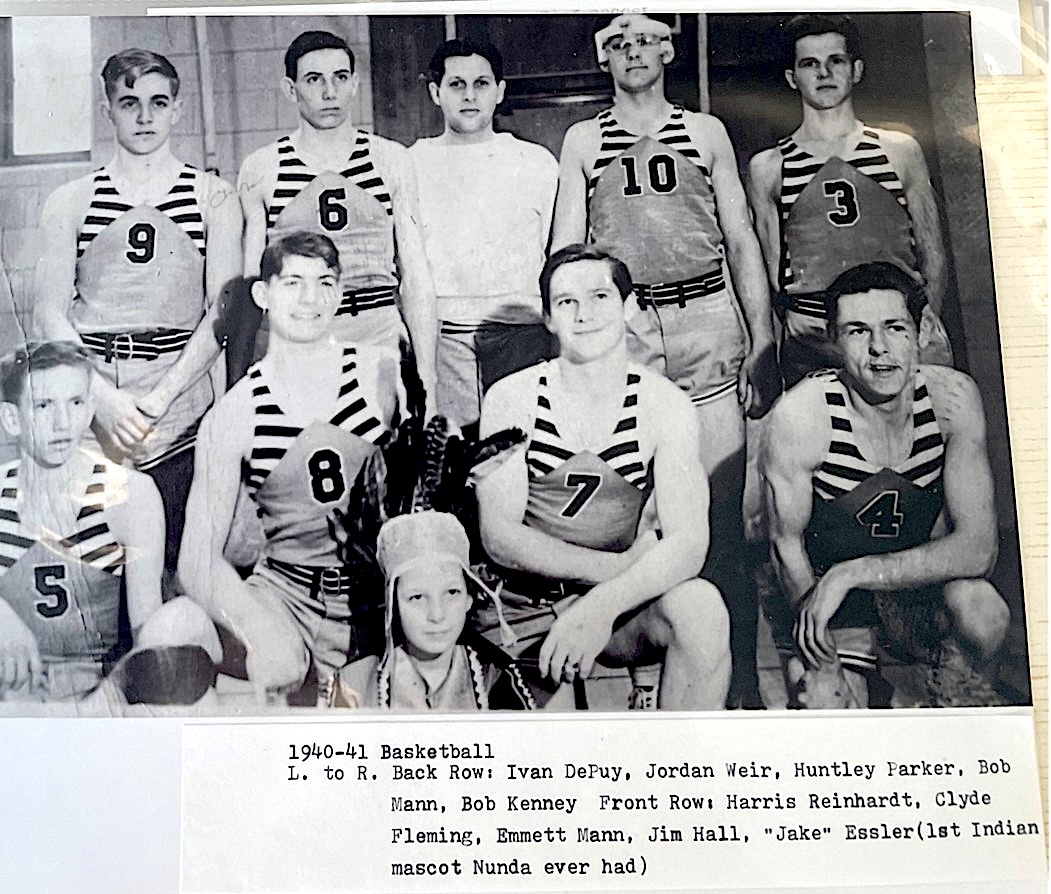
Emmett “Squat” Mann and the 1940–41 Nunda team.
Freeman Barber iFreeman Barber is known in our area as building Nunda’s first golf course. In 1943, Freeman was the first basketball player to tie the single game scoring record with 25 points. The game was played at Mt Morris with Nunda winning 46-34. Gus Ganakas, who went on to coach basketball at Michigan State University in the 1970’s was a player for Mt Morris. After graduation, both Freeman Barber #9 and Ernie Goll #8 went on to play several years for the Nunda Town teams in basketball. See below.
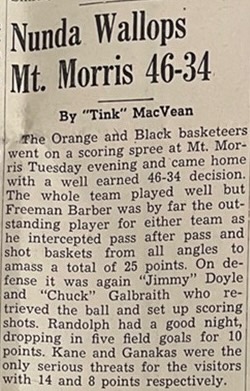
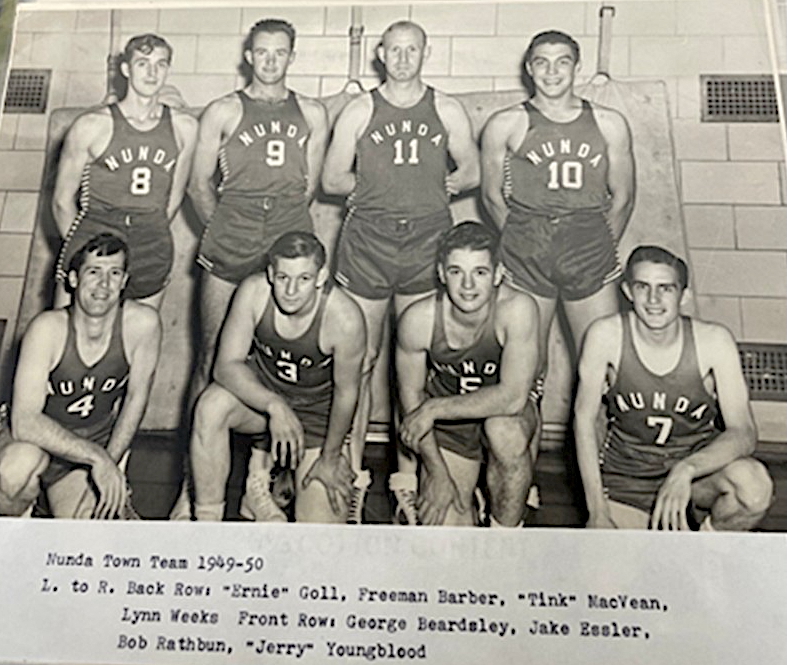
Freeman Barber and Ernie Goll later played on Nunda town basketball teams.
In the 1950’s the style of play increased in pace with higher scoring games. Teams with a good balance of outside shooting and strong inside play by the team center usually had the winning combination. As the 1955-56 regular season came to completion, Nunda found themselves qualifying for the Class B Sectionals for the first time since the Ben Johnston led team in 1937. The team led by team center Ebbon Johnson’s 20.9 points per game in the 1955-56 season helped set a team game scoring record of 92 points against Mt Morris. The record of 25 points that was set by Ben Johnston in 1937 and tied in 1943 by Freeman Barber, was surpassed three times that season by Ebbon Johnson with the final record being set at 41 points by Ebbon against Livonia in a 83-54 win. Ebbon Johnson #30 holding the basketball is shown below.
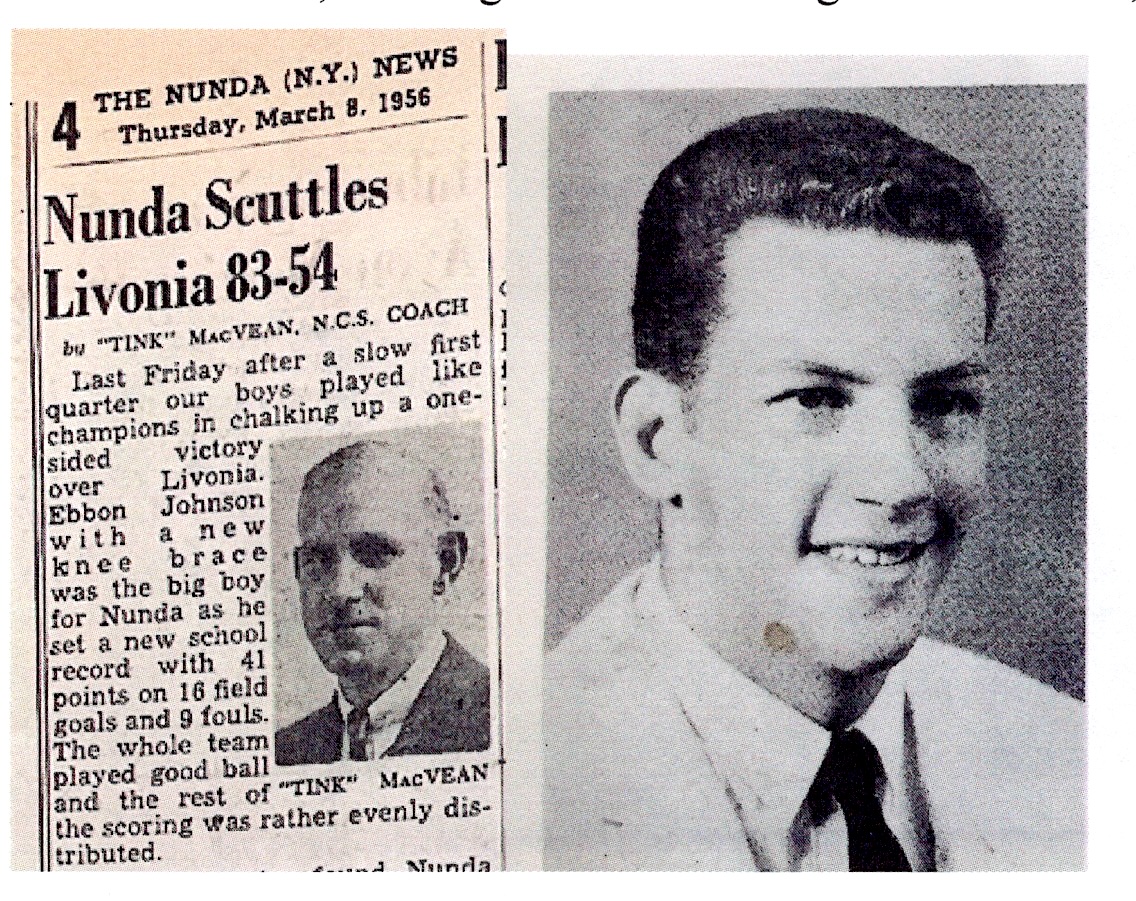
Ebbon Johnson
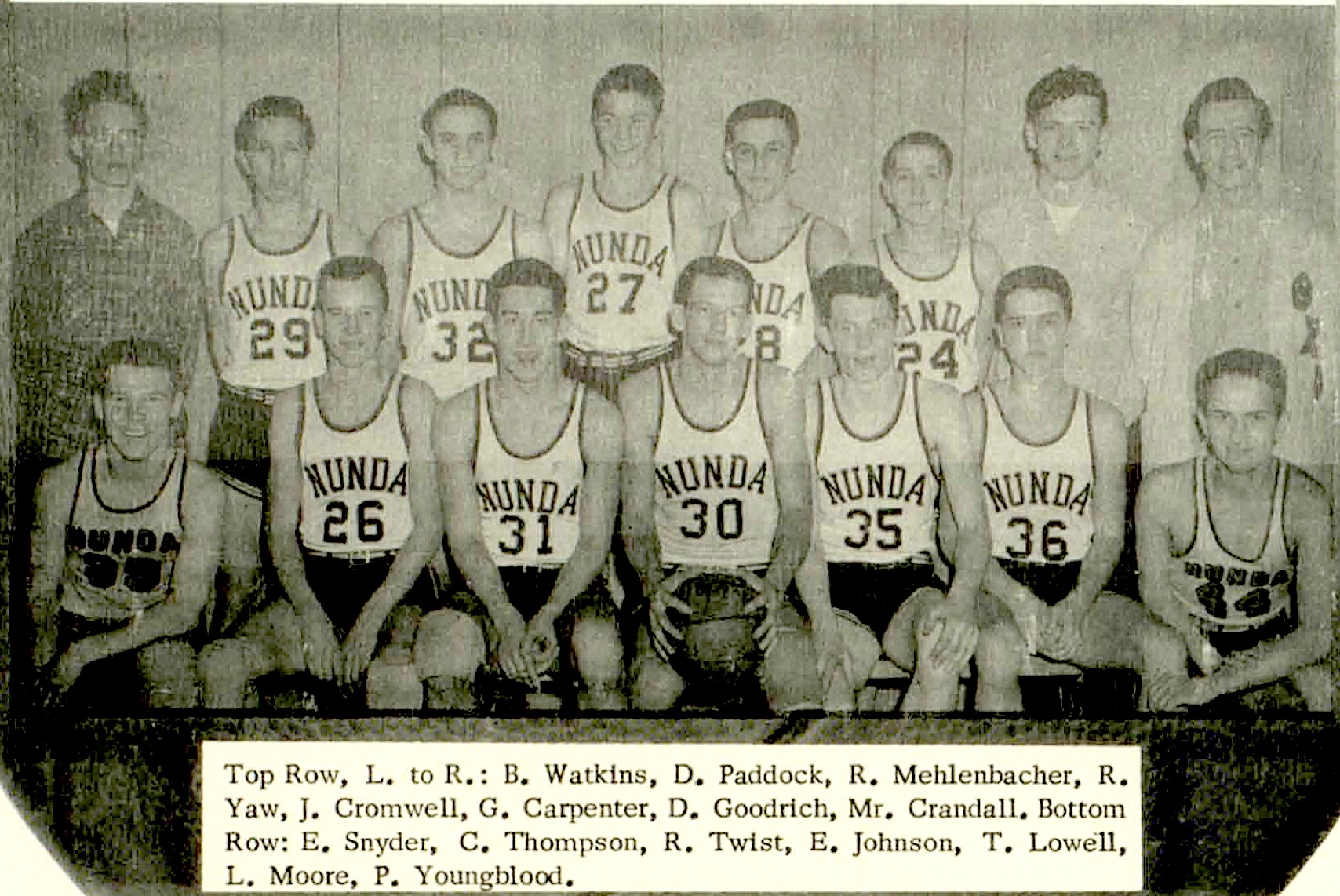
Ebbon Johnson, wearing #30 and holding the basketball, with the 1955–56 team.
In 1962, Don Martin completed his Varsity Basketball career with a 21.1 points per game scoring average. This was the first time a Nunda Basketball player’s career average was over 20 points per game in school history. During the 1961-62 season Don Martin also broke Ebbon Johnson’s game record by scoring 46 himself against Lima in a 91-66 win. The following year, Don Martin attended Syracuse University where he participated on the freshman team with Jim Boeheim who is in the National Basketball Hall of Fame after coaching the Syracuse Men’s Basketball team for 47 seasons. Don Martin is shown below with his 1961-62 teammates.
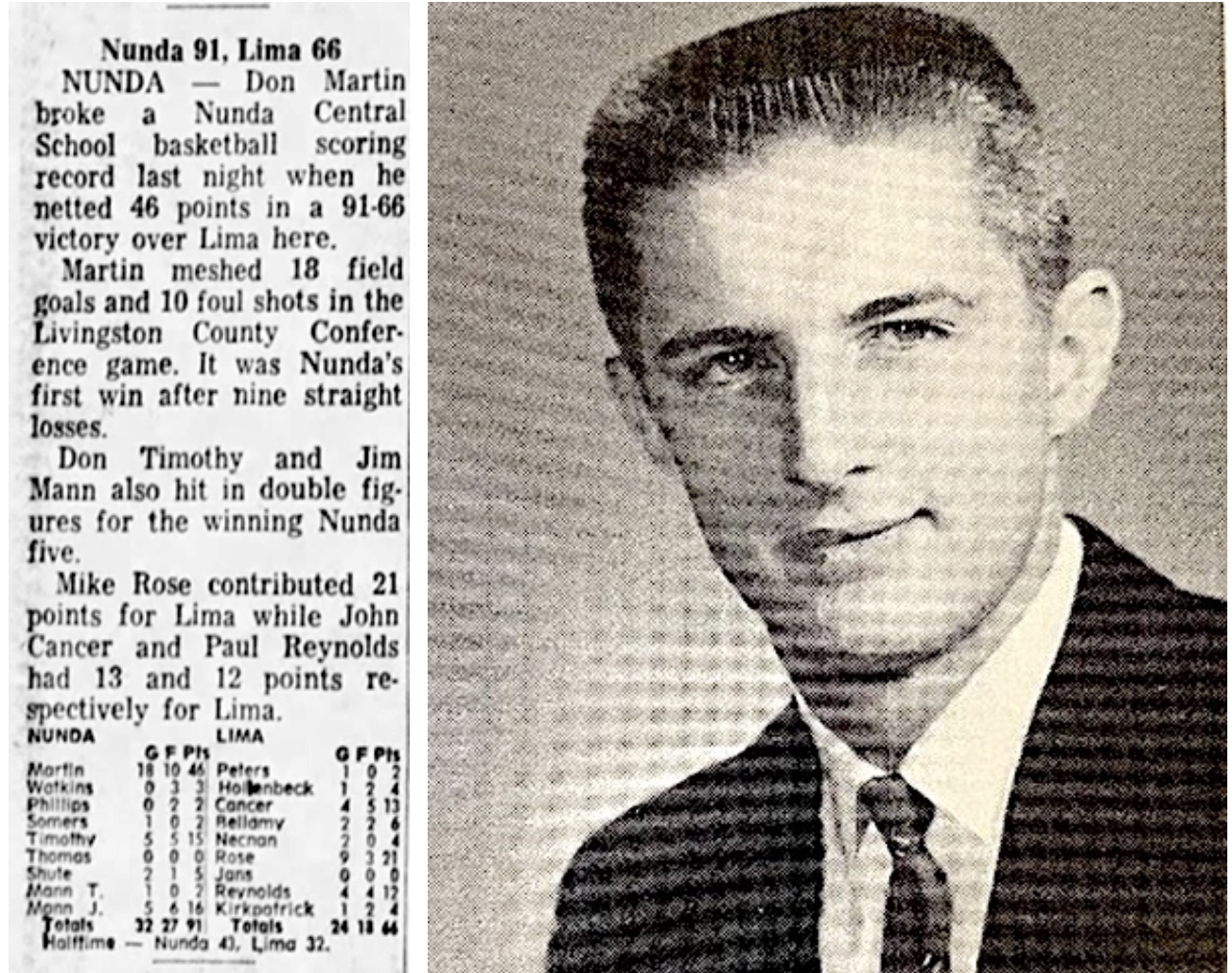
Don Martin
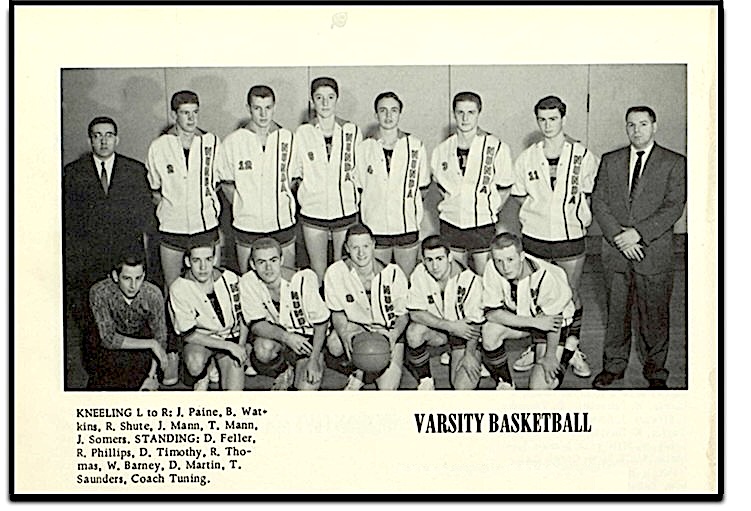
Don Martin with his 1961–62 teammates.
In the 1960’s it was rare to attend a high school basketball game without a member of the Timothy family in the line-up. Two sets of brothers (Don ’61, Dean ’66, Dana ’69) and (Tom ’65, Jack ’68) were all key members of the teams from that decade. Our school officially made the transition to Keshequa Central School in the 1968-69 school year. During that basketball season Dana Timothy broke the single game scoring record with a 47 point performance in a 96-58 win over Letchworth. The 96 point team total is still a record that stands today. Dana Timothy with basketball is shown below with his teammates.
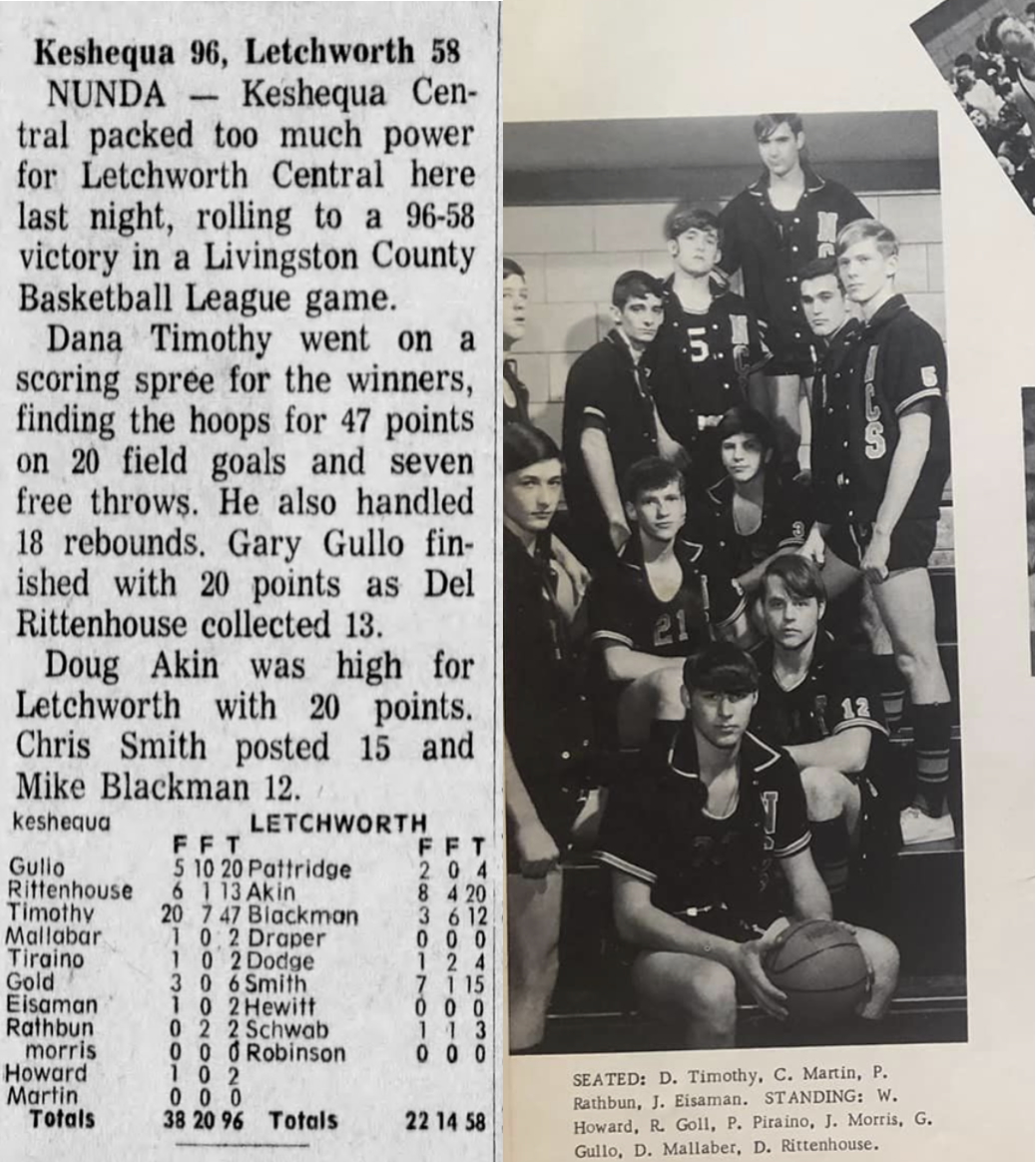
Dana Timothy and his Keshequa teammates.
Rule changes including the adoption of a shot clock and 3 point shooting increased scoring opportunities for players from 1990 to present. The 35 second shot clock prevented teams from slowing down the game and limiting scoring opportunities for an opponent. The 3 point line offered increased scoring for good outside shooters being credited for 3 points instead of 2 for a shot outside the 3 point line.
From 1983 to 2006 the school had (4) 1000 point career scorers who were not able to break Dana Timothy’s single game record of 47 points. In 1983, Tim Diemoz with 1080 career points had a high scoring game of 36 points. In 1993, Rob Baldwin with 1727 career points had a high scoring game of 41 points. In 1994, J.J. Garwood with 1181 career points had a high scoring game of 41 points. In 2006, Eric Kanouse with 1006 career points had a high scoring game of 35 points.
57 years after Dana Timothy’s record breaking game, the record was first tied, then later surpassed by Aiden Upright. Aiden first tied the record with a 47 point performance against Hammondsport. Coach Abijah Gath checked the scoring records to ensure Aiden’s position on the single game scoring list, not knowing that Aiden Upright had one more big game in the near future. In a game later that season, Aiden with 27 points scored in the 4th quarter alone, totaled 48 points against Perry to capture the high scoring game in Keshequa-Nunda Basketball History. What added to the irony of this accomplishment was that a guard on this team, Aiden Howe was Dana Timothy’s grandson! Aiden Upright who finished his career with 1153 points is shown below with the 2025-26 team.
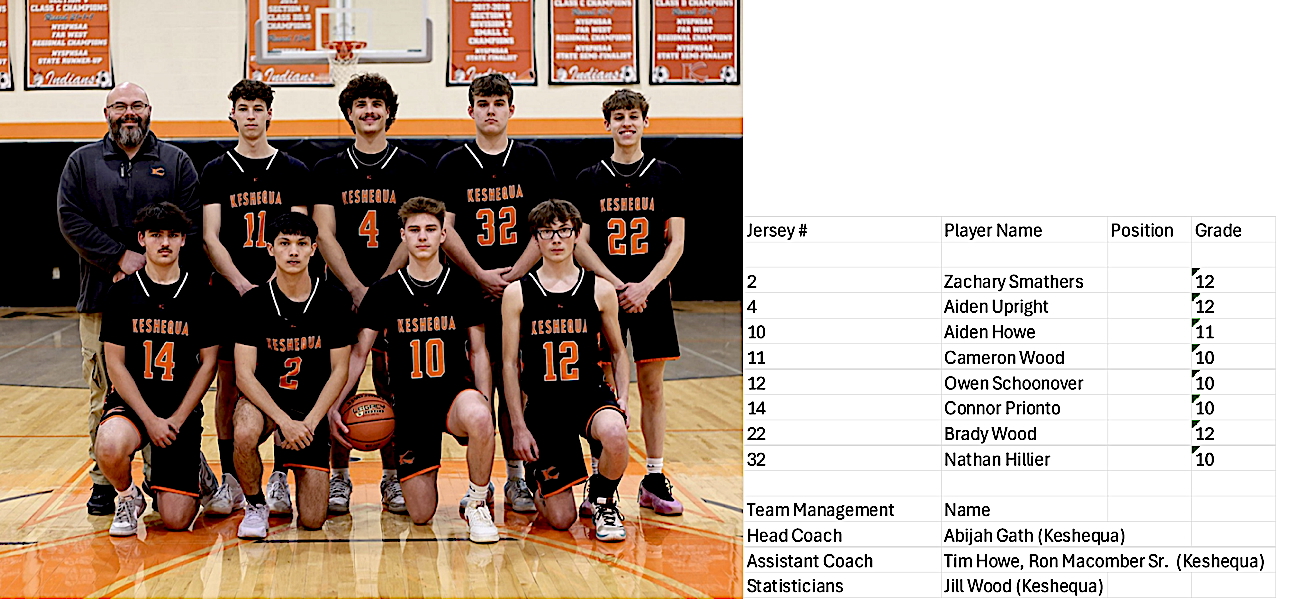
Aiden Upright and the 2025–26 Keshequa basketball team.
Single Game Record History
| Year |
Player |
Points |
| 1937 | Ben Johnston | 25 |
| 1943 | Freeman Barber | 25 |
| 1956 | Ebbon Johnson | 41 |
| 1962 | Don Martin | 46 |
| 1969 | Dana Timothy | 47 |
| 2026 | Aiden Upright | 47 |
| 2026 | Aiden Upright | 48 |
Conclusion
Over 500 basketball player’s have suited up for Nunda or Keshequa during the time frame listed above. I am sure several players might have imagined making this list while shooting on their home basketball hoops or at the local gymnasiums. To date, the six players listed have solidified their place in Keshequa – Nunda Basketball history as Single Game Scoring Leaders.
Acknowledgements
I would like to thank Richard Kemp, Abijah Gath, and Tom Cook for their input in order to complete this document.
|